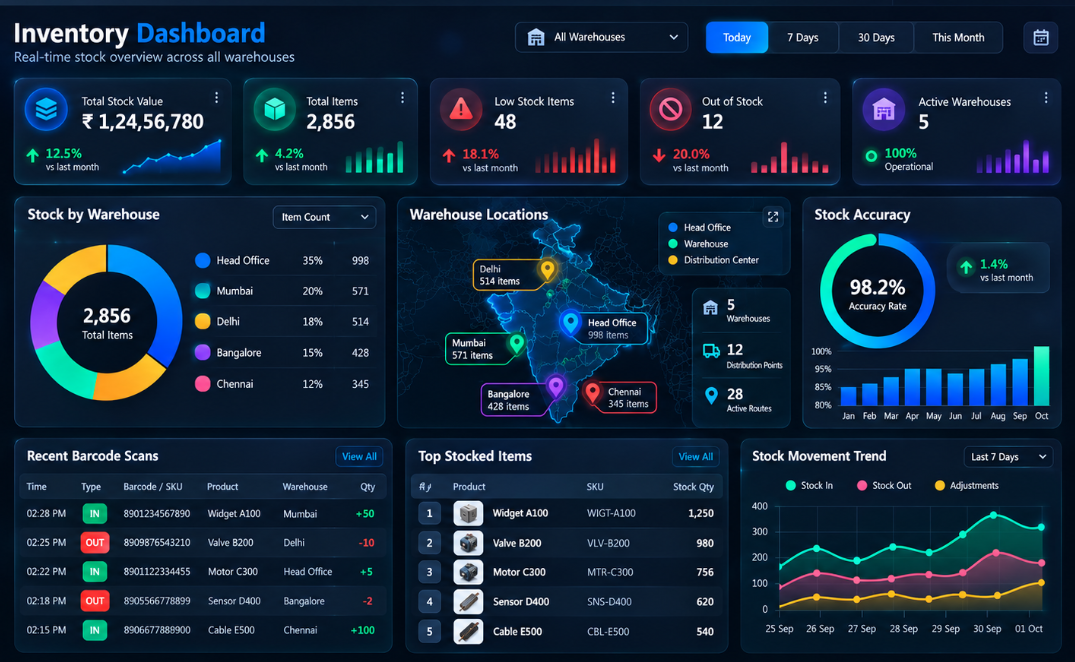
Prevent stockouts, eliminate manual counting errors, and slash holding costs. ERPPWA unifies aisle-rack-bin location numbering, 1D/2D barcode generation, serial number lifecycles, unit-subunit conversions, and automated min-max reorders.
Hear how ERPPWA eliminates stockouts, automates barcode/QR picking, manages multi-warehouse bin locations, and maintains 100% stock precision.
Audio Summary: This briefing explains how ERPPWA Inventory Management eliminates stockouts, counting discrepancies, and dead inventory through real-time multi-warehouse bin locations, integrated barcode/QR scanning, and automated reorder triggers.
Key Topics Covered:
Manufacturing facilities struggle when product masters, stock balances, shop-floor issues, and dispatches live in separate spreadsheets. Here is how ERPPWA brings order to factory operations:
A single stock number hides unbilled dispatches, pending vendor arrivals, and materials already reserved for active production jobs. ERPPWA's multi-column Stock Statement reveals Opening, Inward, Outward, Stock, DNI, DNO, PO Remaining, SO Remaining, and Reserves side by side.
Drawings, HSN codes, main/sub units, reorder thresholds, and vendor prices live in isolated departmental files. The ERPPWA Product Master consolidates engineering, commercial, and inventory parameters in one searchable home.
Engineers and data entry clerks spend hours recreating similar items from scratch. With Copy This Product, clone any base item's attributes, BOM, and process routing in one click, updating only variant-specific dimensions.
Raw material requirements live outside product masters, forcing manual estimation during order execution. ERPPWA associates structured, multi-level BOMs with scrap percentages directly to each product.
Materials move onto the factory floor via verbal requests and scratchpads. Dedicated vouchers for Materials Issued to Production (SRM), Finished Goods In, and Stock Transfers establish an unbroken audit trail.
Foreign currency import costs and multi-step markups lead to inaccurate selling quotes. ERPPWA's Costing Breakdown and Pricing Waterfall calculate landed costs, exchange rates, and profit margins automatically.
Accountants and auditors cannot verify how an item reached its current balance. ERPPWA allows 1-click drilldown from any stock number directly to the supporting GRN, invoice, issue slip, or adjustment voucher.
Stock sitting in transit or segregated across raw material sheds, WIP stages, and finished goods godowns creates artificial shortages. ERPPWA tracks location-specific bin balances with formal Transfer Inventory gate passes.
From initial product engineering to procurement, shop-floor issue, finished goods receipt, and dispatch audit:
Create raw materials, components, sub-assemblies, and finished products. Record technical dimensions, main/sub stock units, HSN classification, tax slabs, supplier codes, customer part mappings, and reorder levels. Attach engineering CAD drawings and spec sheets.
Build multi-level Bill of Materials (BOM) with scrap percentage allowances and identify mandatory vs. optional configurations. Detail sequential manufacturing processes with target cycle times, workstations, and subcontracting stages.
Review the Stock Statement to evaluate live balances alongside open Purchase Orders, pending sales commitments, and reserved shop-floor materials. Low-stock alerts automatically populate the Low Stock Register to trigger timely replenishment.
Issue materials from warehouse stock to the production floor via Materials Issued to Production (SRM) vouchers tied to Job Cards. Move stock between warehouse bins with Transfer Inventory vouchers and record non-invoiced corrections with Stock Journals.
Upon job completion, generate Finished Goods In vouchers recording inspected output, batch/serial numbers, and calculated unit manufacturing costs into Finished Goods warehouses, making them instantly available for sale.
Examine the Products Summary audit report, track historical product name amendments via Product Name History, verify inventory valuation in Stock Statement Beta, and review destroyed goods records to minimize factory scrap.
When inventory talks natively to purchasing, shop-floor production, sales, and accounts, your entire enterprise operates on one single source of truth:
Reorder settings in Product Master populate the Low Stock Register. Purchase teams generate RFQs and vendor Purchase Orders directly from verified deficits, while the Stock Statement highlights POs still awaiting inward delivery.
Product BOMs drive accurate material requisition (SRM), ensuring the floor never runs dry mid-assembly. Completed job output creates Finished Goods In vouchers, calculating actual landed production costs automatically.
Sales reps verify available-to-promise stock before committing delivery schedules. Customer-specific drawing numbers prevent fulfillment errors, while standard packing list items attach automatically to dispatches.
Stock Statement Beta delivers instant monetary inventory valuations at weighted average costs. Scrap and destroyed materials reflect in proper accounting expense accounts without physical count audit shocks.
Explore all 20 verified inventory features built into ERPPWA. From Product Master specifications, BOM mapping, foreign currency costing, and multi-warehouse bin management to SRM production issues, finished goods inwards, and multi-column stock statements.
Complete Technical, Identification, and Commercial Master Data
The Product Master serves as the single source of truth for all materials used across your manufacturing and trading lifecycle. It supports 5 distinct product types: Raw Material, Component, Sub-Product, Master Product, and Semi-Finished Product.
Multi-Tier Commercial Controls, Foreign Currency & Pricing Waterfalls
ERPPWA supports comprehensive multi-tier pricing fields on every product record, eliminating guesswork when quoting customers or valuing stock.
Custom Engineering Specification Sheets for Commercial Offers
Machinery and engineered equipment require rich, technical spec sheets attached to quotations. ERPPWA provides a visual layout designer inside the Product Master.
Multi-Level Raw Material Mapping, Scrap Allowances & Assembly Links
Associate required components, sub-assemblies, and raw materials directly with finished products in the Product Master.
Sequential Manufacturing Routing, Workstations & Cycle Times
Define the step-by-step manufacturing operations required to turn raw stock into finished goods directly inside the Product Master.
Manage Standard Accessories, Fasteners and Dispatch Inclusions
Certain finished products include standard free accessories, mounting hardware, power cables, or test certificates that warehouse staff must pack prior to dispatch.
Cross-Reference External Vendor Codes and Client Part Numbers
Suppliers call a component by their catalogue number, while corporate buyers reference their own internal drawing code. ERPPWA bridges this gap inside the Product Master.
Secure Engineering Drawings, 3D Models, and Quality Certificates
Attach technical 2D drawings (PDF), 3D CAD models, material test certificates (MTR), and RoHS/CE compliance sheets directly to the product record.
Multi-Location Godowns, Bins, and Inter-Warehouse Transfers
Manage physical inventory across multiple factory buildings, regional warehouses, transit godowns, and third-party jobwork processing yards.
Store Requisition Material (SRM) Vouchers Linked to Work Orders
Prevent unrecorded raw material consumption by releasing materials to the factory floor only against verified Store Requisition Material (SRM) vouchers.
Record Completed Production Batches Into Finished Warehouse
Upon final quality clearance, completed manufacturing jobs generate a Finished Goods In inward voucher to update warehouse inventory.
Formal Scrap Vouchers, Reason Classifications & Audit Logs
Damaged raw materials, expired chemical compounds, or machining rejects cannot simply vanish from the warehouse without formal explanation.
Auditable Non-Invoiced Physical Count Adjustments
Maintain accurate physical stock counts without tampering with commercial purchase orders or customer sales invoices.
The Ultimate Multi-Column Manufacturing Stock Intelligence Report
Conventional ERPs show only a bare 'Closing Stock' number. ERPPWA provides a comprehensive, multi-dimensional view of your actual inventory position:
| Column | Operational Significance for Manufacturers |
|---|---|
| Opening | Stock balance carried forward from the previous financial year. |
| Inward | Total material received via Purchase Invoices and inward vouchers. |
| Outward | Total material issued or sold via Sales Invoices and outward vouchers. |
| Stock | Physical on-hand quantity currently resting in warehouse racks. |
| DNI (Delivery Note In) | Material physically received from suppliers but awaiting purchase bill entry. |
| DNO (Delivery Note Out) | Material physically dispatched to customers before sales tax invoice generation. |
| PO Remaining | Quantity confirmed on approved vendor Purchase Orders not yet received. |
| SO Remaining | Committed sales order quantities waiting for production or dispatch. |
| Reserve | Material locked on the factory floor for active Job Cards. |
| Order / Excess | Net calculated requirement indicating true purchase deficit or surplus inventory. |
Monetary Stock Valuation at Weighted Average Rates
Finance directors and business owners need to know the exact rupee value of stock tied up in raw materials, WIP, and finished inventory.
Complete Master Data, Prices & Inventory Parameters in One Panoramic View
Audit your complete product database across hundreds of attributes in a single wide reporting interface with search, column filters, and export tools.
Immutable Audit Trail of Product Renaming & Modifications
When a product name is corrected or revised, historical invoices, POs, and job cards must remain auditable without confusion.
High-Value Productivity Tools for Growing Factory Operations
Scanning an ERPPWA product QR code during invoice creation adds that product immediately to the line items without manual typing.
Maintain discrete serial numbers for high-value items, track warranty history, and follow serial numbers from production through customer invoice.
Merge two accidentally created duplicate items into one master record, consolidating transaction history seamlessly.
Update purchase prices across all products under a specific brand or supplier in one batch action when a vendor revises their price list.
Seamless Material Handshakes Between All 10 Core Modules
Every material transaction in ERPPWA triggers corresponding movements across supply chain, production, and accounting ledgers:
Summary of All Core Operational Documents & Reports
| Voucher / Report | Primary Function & Purpose |
|---|---|
| Materials Issued to Production (SRM) | Issues raw materials and components from warehouse to a specific shop-floor job card. |
| Finished Goods In | Receives completed, inspected production units from manufacturing into finished goods warehouse. |
| Transfer Inventory | Transfers stock between multiple warehouses, godowns, or transit bins with gate passes. |
| Destroyed Goods | Documents scrap, transit breakage, and damaged inventory write-offs with audit justifications. |
| Stock Journal In / Out | Processes permanent non-invoiced stock adjustments for physical count audit reconciliations. |
| Stock Statement Report | Displays multi-column stock balances, unbilled DNI/DNO, PO/SO commitments, and net reorder deficits. |
| Stock Statement Beta | Provides monetary valuation of inventory based on weighted average purchase pricing. |
| Products Summary | Wide catalogue audit table for monitoring master data, taxation, units, and rack locations. |
| Product Name History | Chronological audit log tracking historical product name amendments, users, and timestamps. |
Eliminate lost stock and inventory discrepancies. ERPPWA links your vendor receipts, bin put-away, barcode generation, serial tracking, production issues, and dispatch slips into one synchronized pipeline.
Verify inbound deliveries against vendor Purchase Orders. Auto-convert supplier billing units (e.g. Tonnes/KGs) into internal stock units with automated tolerance checks.
Auto-generate 1D Barcodes and 2D QR stickers. Assign goods to designated warehouse zones, aisles, racks, and bin locations for instant picker navigation.
Assign unique serial numbers to finished machines and sensitive components. Log QC inspection parameters, test certificates, and warranty parameters.
Issue raw materials directly to shop-floor manufacturing against Work Orders in 1 click. Move items to WIP and deduct stock automatically with mathematical precision.
Transfer inventory across branch warehouses with in-transit tracking. Record damaged goods scrap and Stock Journals for 100% audited book balance.
Pick and scan items via mobile barcode readers for dispatch. Generate Delivery Outward Challans, pack slips, and convert to GST Tax Invoices in 1 click.
Explore how ERPPWA eliminates stock leaks, solves multi-unit conversion chaos, and streamlines multi-warehouse distribution.
Stock scattered across central warehouses, regional godowns, and shop floors causes phantom stockouts. Pickers wander warehouse aisles aimlessly searching for items, and inventory transferred between locations vanishes into transit black holes.
Centralize multi-warehouse operations with pinpoint bin-level visibility. Organize every warehouse into structured Zones, Aisles, Racks, and Bins with a standardized Location Numbering System. Execute seamless Stock Transfers between locations with dedicated dispatch and receipt reconciliation.
Cut order picking times by up to 60% with instant digital bin navigation.
Schedule Guided Demo →| Product / SKU | Warehouse Location | Bin Location Code | Available Qty |
|---|---|---|---|
| Hydraulic Valve 80mm SKU-HYD-80 |
Plant 1 • Central Godown | Aisle-B • R-04 • B-12 | 320 Pcs |
| SS316 Precision Flange SKU-FLG-SS316 |
Plant 2 • Forging Store | Aisle-A • R-01 • B-05 | 1,450 Pcs |
| Alloy Steel Dowel Pins SKU-PIN-EN31 |
Transit: Plant 1 → Plant 2 | In-Transit (TRF-104) | 500 Pcs |
Manual clerical entry at goods inward and dispatch packing leads to severe human errorsβwrong SKU dispatches, misplaced batches, and slow stock counting. Expensive proprietary handheld terminals require dedicated IT configurations.
Transform your warehouse into a paperless, barcode-driven hub. ERPPWA includes native 1D Barcode and 2D QR Code generation. Print standardized label stickers directly on thermal printers, and scan barcodes using any mobile phone camera or standard wireless USB scanner.
Eliminate shipping errors and accelerate inward receiving by up to 80%.
Schedule Guided Demo →| Scanned Item / SKU | Barcode / QR Value | Batch / Serial No | Scan Verification |
|---|---|---|---|
| Flange SS316 4-Inch | |||| ||| ||||||| 890124 | BATCH-2026-B8 | β VERIFIED • INWARD |
| Hydraulic Cylinder 80mm | QR: HYD80-SN99142 | SN-2026-099142 | β PICKED FOR DISPATCH |
| En31 Ground Dowel Pins | |||| ||| ||||||| 890128 | BATCH-2026-B9 | BIN VERIFIED: B-05 |
Suppliers invoice raw materials in Tonnes, KGs, or Rolls, but production consumes them in Meters, Grams, or Pieces. Trying to manually calculate conversion ratios in spreadsheets corrupts physical stock ledgers, inflates unit costs, and causes financial accounting havoc.
Master multi-unit complexities with automated conversion factors. ERPPWA supports Main Units, Subunits, and dedicated Supplier Units per item. When an inward purchase voucher is created in the supplier's billing unit, the system auto-converts and stocks the material in your factory's base unit automatically.
Eliminate unit mismatches forever and purchase in bulk with complete accounting clarity.
Schedule Guided Demo →| Material / Item | Supplier Unit | Conversion Ratio | Stock Base Unit |
|---|---|---|---|
| SS304 Wire Rod Coil | Tonne (MT) | 1 MT = 1,000 KGs | 1,000 KGs (Base) |
| Hydraulic Rubber Hose | Roll (50 Mtr) | 1 Roll = 50 Meters | Meters (Base) |
| Standard Fastener Pack | Box (500 Pcs) | 1 Box = 500 Pieces | Pieces (Base) |
When a customer files a warranty claim or a component fails in the field, manufacturing enterprises cannot trace which raw material batch, vendor PO, machine operator, or shipment date that specific unit originated from, causing massive warranty liabilities.
Track every serialized product from cradle to grave with Serial Number History. Assign individual unique serial numbers at inward receiving or finished goods assembly. Trace its complete lifecycle: Purchase Bill → QC Inspection → Warehouse Bin → Production Issue → Customer Tax Invoice.
Achieve aerospace and automotive ISO/IATF audit compliance with 100% component trace.
Schedule Guided Demo →| Event Stage | Document / Ref | Location / Person | Timestamp & Status |
|---|---|---|---|
| 1. Inward GRN | PO #SAC-8812 • Bill #412 | Gate 1 Inward Store | QC PASSED • 04-OCT |
| 2. Bin Put-away | Bin Slip #B-12 | Central Godown R-04 | STOCKED • 04-OCT |
| 3. Dispatch Out | DC #081 • INV #442 | Bharat Heavy Machineries | ACTIVE WARRANTY |
Materials arrive at the factory gate without immediate vendor purchase bills, or dispatches leave warehouses on urgent delivery challans without immediate tax invoices. These untracked shipments create unbilled inventory floats and severe reconciliation leaks.
Gain total control over physical gate dispatches vs commercial billing. Dedicated All Inward (Delivery In / GRN) and All Outward registers track every gate entry. Real-time "Pending to Invoice" status alerts immediately flag unbilled inward receipts and outward deliveries.
Ensure zero unbilled dispatches and maintain 100% financial audit integrity.
Schedule Guided Demo →| Slip No / Partner | Type & Material | Quantity | Billing Status |
|---|---|---|---|
| DIN-2026-104 Pooja Steel Ltd |
Delivery In • Raw Flanges | 500 Pcs | Pending Vendor Bill |
| DOUT-2026-082 Shreeji Auto |
Delivery Out • Finished Flanges | 250 Pcs | β‘ Convert to Invoice |
| DOUT-2026-083 Bharat Heavy |
Delivery Out • Valves | 18 Units | β Invoiced (INV-442) |
Raw materials vanish onto shop floors without work-in-progress (WIP) deductions. Damaged components, machine scrap, or expired materials get quietly swept aside, corrupting inventory valuation and creating embarrassing audit discrepancies.
Seamlessly integrate inventory with shop floor manufacturing. Issue raw materials directly against Work Orders in 1 click, automatically deducting warehouse stock and updating WIP. Log damaged, destroyed, or scrap goods with audit reasons via Stock Journals.
Keep warehouse stock and shop-floor manufacturing in perfect mathematical sync.
Schedule Guided Demo →| Voucher / Ref | Material / Component | Qty Issued / Scrap | Status & Impact |
|---|---|---|---|
| MIP-2026-042 WO #8812 • CNC Line |
SS316 Solid Round Bar | 250 KGs Issued | WIP • AUTO-DEDUCTED |
| SCRAP-2026-014 Forging Die Heat Crack |
Forged Blank C-45 | 12 Pcs Damaged | SCRAP LOGGED • AS-2 |
| MIP-2026-043 WO #8815 • Assembly |
Hydraulic Seals Kit | 40 Kits Issued | β ISSUED TO OPERATOR |
Stock-outs unexpectedly shut down assembly lines, forcing emergency procurements at inflated market prices. Meanwhile, dead stock sits in forgotten bins for years without tracking which purchase bill it was bought against.
Never run out of critical inventory with automated Min-Max reorder algorithms. Set safety buffer thresholds per item. When stock dips below minimum levels, ERPPWA triggers proactive purchase alerts. Track stock on a Purchase Bill-wise basis, linking every unit directly to its vendor rate and purchase date.
Prevent manufacturing downtime and reduce carrying holding costs by up to 35%.
Schedule Guided Demo →| Item / Material | Current Stock | Min Threshold | Purchase Bill Ref |
|---|---|---|---|
| Flange Gasket (4-Inch) | 12 Pcs | 50 Pcs | β‘ Auto-PO Trigger |
| Hydraulic Cylinder 80mm | 18 Pcs | 25 Pcs | PB-2026-8812 • βΉ3,400/pc |
| SS316 Flange Blanks | 450 Pcs | 100 Pcs | PB-2026-8815 • βΉ1,150/pc |
Different staff create duplicate item masters with minor spelling variations (e.g. "SS Flange" vs "Stainless Flange"), splitting stock balances and causing catalog chaos. Technical drawing blueprints and CAD files get scattered across email threads and lost.
Maintain pristine catalog governance. ERPPWA features a 1-Click Duplicate Products Merge facility to unify duplicate items while safely preserving transaction histories. Quickly create similar items via the Copy Product tool, and attach product photos, CAD blueprints, and spec sheets with custom document titles directly to the item record.
Empower engineers and storekeepers with a single unified catalog of truth.
Schedule Guided Demo →| Catalog Action | Source Item | Target / Execution | Result |
|---|---|---|---|
| Merge Duplicate | "Hyd Valve 80mm" (Duplicate) | → SKU-HYD-CYL-80 | β MERGED (18 TXNs) |
| Copy Product | SKU-HYD-CYL-80 | Create SKU-HYD-CYL-100 | COPIED IN 5s |
| Drawing Attach | CAD Section Blueprint | Title: "Approved Assembly Drw" | ATTACHED |
Stop relying on disconnected product records, manual stock registers, and unverified warehouse spreadsheets. Explore how ERPPWA systematically resolves 42 distinct manufacturing inventory friction points with synchronized masters, batch-traceable vouchers, and live audit trails.
Product descriptions, part numbers, composition, tax information and measurements are kept in separate files. Teams use different versions when they buy, quote or manufacture.
The ERPPWA Product Master combines product identity, composition, product type, units, packing, tax/HSN, pricing and stock-control fields in one record.
A manufacturer must create many similar items or variants, repeating the same attributes for each one.
Copy This Product duplicates an existing productβs details while users enter one or more new product names.
A mixed catalogue contains raw materials, sub-products and finished products, but the information required to distinguish them is inconsistent.
Use Product Type, Category, Manufacturer, Brand, Composition and other Product Master fields to organise the catalogue.
Product drawings and instructions are scattered in messages or duplicated across team folders.
Product Documents lets users upload relevant new documents or attach files already held within ERPPWA.
The supplier uses its own identifier, making it difficult for purchasing staff to match quotes with the internal product.
Product Suppliers associates a supplier, supplier part number and configured price with the ERPPWA product record.
A manufacturing customer orders with its own material code, but Sales and Stores recognise the product under a different identifier.
Product Customers maintains the customer relationship, Customer Material Code and customer-specific price against the internal product.
Raw-material lists live in separate files, making it difficult to recognise which components belong to a manufactured product.
ERPPWA attaches a BOM to a master product, listing component names, quantities, costs and a Total BOM Cost, and makes that BOM available for Production jobs.
A customised assembly may have compulsory parts and customer-selectable options, creating confusion during definition or quotation.
Product BOM supports Mandatory and Optional classifications. All configured BOM items, including Optional lines, initially populate the production job; the job can then be edited independently of the master template.
Production teams may define work steps and estimated hours differently for the same manufactured product.
Product Process records process name, man-hours, execution information and cost per hour against the product, and those records are available in jobs.
Free accessories or small items supplied with a master product are managed informally and may be missed during preparation.
The Product Packing List records included/free products and quantities. When the master product is entered on a Sales Invoice or DNO, ERPPWA automatically adds these Packing List items; their quantities can be edited per sale and their stock is deducted through the related workflow.
Engineering quotations need detailed product descriptions that employees otherwise rewrite and reformat for every customer.
Product Detail Template lets teams arrange bound fields, editable quotation inputs and layouts, then preview the result for quotations and A4 print.
A single cost number hides labour, handling, transportation and packing elements needed to review pricing assumptions.
Costing Breakdown records base cost and additional fixed or percentage components, with itemised values and Final Cost Price.
When a product is sourced in another currency, the buying cost and base-equivalent calculation are harder to compare within the same product record.
The Product page stores foreign currency prices and a manually entered exchange rate, calculates the resulting Cost Price, and shows editable price/rate values in applicable vouchers.
A salesperson or product manager needs to propose a selling price based on a target margin or markup but currently works it out manually.
The Product Price Calculator accepts a Margin / Markup % and shows Current Cost and Calculated Price before Apply.
A list price is adjusted through discounts, extra costs, handling and modification charges, making the result hard to explain.
MRP Pricing Waterfall displays a selected template, step values, step impacts, running totals and a final price.
Product configurations can add percentage-based costs that change with the specification, and these values are easily lost across files.
Costing Waterfall includes an EXTRA COST configuration where users maintain named options and their percentage rates.
To review pricing across many products, staff otherwise open product records one by one.
Products Summary displays product, unit, supplier-price, cost, sale-price, MRP, profitability and related master fields in a wide report.
Managers see a stock quantity but cannot easily understand outstanding supplier orders, customer commitments and reservations.
Stock Statement shows Opening, Inward, Outward, Stock, DNI, DNO, PO Remaining, SO Remaining, Reserve and Order / Excess. The owner confirmed `Stock + DNI β DNO + PO Remaining β SO Remaining + Reserve` as the Order / Excess formula.
An inventory report contains a number that colleagues question, but the contributing entries are difficult to locate.
Clickable quantity cells in the Stock Statement open supporting records, such as DNI entries behind a DNI number.
Opening balance, sales, manufacturing and other inventory transactions are recorded at different points, so locating an itemβs history takes time.
Click a product in the Stock Statement to open its Stock Balance ledger, with transactions, in/out movements, running balances, and clickable vouchers.
Stores and Purchase teams notice material shortages only when a job urgently needs components.
Product Master records Reorder Level and Reorder Quantity, which connect to the Low Stock Register in Purchase Management for selected sourcing actions.
Stock may be physically moved or reserved while its invoice or production process is not complete, making balances easy to misunderstand.
Stock Statement displays separate Reserve, DNI and DNO columns. Reserve is shown after manually generated SRM, while DNI/DNO remain separate from current STOCK until the corresponding invoices are created.
Management needs an aggregate value of inventory as well as item quantities, but the two are maintained separately.
Stock Statement Beta displays stock quantities, an average product price (e.g., βΉ110 for equal quantities bought at βΉ100 and βΉ120), each product Total Amount, and an aggregate value, with warehouse and financial-year filters. This is not proof of a particular statutory valuation method.
Warehouse locations are managed informally, making contact and location data difficult to maintain across the organisation.
ERPPWA Warehouse Master stores warehouse name, address and contact details, and stock reporting can be filtered by warehouse.
Materials moved between stores or locations may be recorded only in emails or a local log.
Transfer Inventory creates a voucher with source warehouse, destination warehouse and transferred item quantities.
A genuine inward stock adjustment needs an attributable record, but the team increases a spreadsheet balance instead.
Stock Journal In provides a dated record when goods are permanently added without an invoice-price calculationβfor example, complimentary screws supplied inside a box. It updates inventory and related accounting entries, without implying an assigned unit cost.
A balance is reduced manually and the reason or responsible transaction is difficult to identify afterwards.
Stock Journal Out records permanent outward movement of unbilled itemsβfor example, an extra item supplied with customer packaging that will not be invoiced or returned. It updates stock and related accounting entries. It is different from an invoice-pending or temporary DNO.
Damaged, expired or unusable items are physically removed while inventory records remain unclear.
Destroyed Goods provides a dedicated voucher and value-based item list, including the loss-allocation head shown in the documented interface.
Some item movements require batch, expiry, part and packing details but ordinary transfer notes omit those fields.
ERPPWA can maintain batch and expiry details. Finished Goods item lines and transfer-related screens include the relevant fields, and expiry dates appear in reports without automatic expiry warnings.
Materials move from Stores to the shop floor, but their job reference and issue details are not recorded together.
Materials Issued to Production (SRM) are manually generated, including directly from the selected job; the issued quantity then appears as Reserve in the Stock Statement. The voucher records item lines and job reference.
Manufacturing finishes a batch but warehouse and production records do not share a clear finished-goods entry.
Finished Goods In provides a dated output voucher with components used to calculate its value; the resulting product price updates the Product page. Exact cost categories and costing policy are not asserted.
Parts are sent to an external machining supplier and later returned, but outward and inward records are confused with service billing.
The owner confirmed the cross-module route: DNO when materials leave for machining, DNI when machined parts return; SPO/SPI manage the service purchase separately.
Product components and processes are defined in one place while manufacturing staff build job plans from separate spreadsheets.
Product BOM and Process definitions are associated with the master product. All configured BOM items populate the new job, then users can edit BOM items or processes for that job without modifying the Product Master template.
A component is renamed and teams cannot relate the old name to the current product master entry.
The Product Name History Report shows old and current names only when an old name is manually entered on the Product page; the report does not automatically log changes or show rename dates.
Managers must open individual products to compare units, tax fields, supplier references, prices and reorder parameters.
Products Summary Report brings a wide set of product master fields into one filterable, exportable table.
Stores, Purchase and Production each produce different spreadsheet extracts of the same inventory question.
ERPPWA Stock Statement and valuation views support product search, warehouse and period filters, column settings, refresh and export.
Duplicate records for the same item can fragment available quantities and confuse staff working from different product names.
ERPPWA merges products only after their pending orders/jobs/processes are complete. Users choose the surviving product and combine quantities; older invoice names are unchanged and merge history is not retained.
A manufacturer wants to identify and review individual serialized motors/components used in invoices and jobs.
Serial numbers are entered and maintained on the Product page, selected on invoices and jobs, and their available history is viewed on that Product page. A comprehensive repair/installation genealogy is not asserted.
Invoice preparation can require manually finding and selecting the same catalogue item each time.
ERPPWA can generate a QR code for a product. Scanning it within the invoice workflow adds that product to the invoice. A normal mobile-phone scan displays the QR number.
A supplier bills in tonnes while stores measure in kilograms, increasing the risk of inconsistent manual quantity conversion.
Conversion details are maintained on the Product page. When a Purchase Invoice is created from a PO, the user enters the received quantity in tonnes and ERPPWA calculates the equivalent kilograms and amount.
For make-to-order work, managers need to distinguish quantities purchased for different jobs and find unused quantities from a specific purchase bill.
A Purchase Invoice can be tagged with a Job No.; Stock Summary can be viewed by job and users can inspect remaining stock linked to a particular Purchase Invoice.
A supplier/manufacturer announces a new price level for every product under a brand, and separate manual edits are inconsistent.
Products Summary supports a brand-wise percentage update (e.g., +10% or β20%) to Purchase Price across the selected brand. Related product prices are recalculated according to the configured pricing.
Every manufacturing and warehouse operation has unique storage workflows, barcode label sizes, and approval hierarchies. With ERPPWA, our software adapts to your proven warehouse layoutβnot the other way around. Our ERP is fully customized to fit your inventory operations.
Enjoy complete architectural sovereignty. Host ERPPWA on our managed encrypted cloud for effortless multi-warehouse mobile access, or deploy it 100% On-Premise on your local factory server for total data privacy and zero internet downtime dependency.
Compare how our modern Progressive Web App architecture eliminates the rigid complexity, exorbitant AMC costs, and missing mobile features of old legacy software.
| Warehouse Capability | ERPPWA Intelligent Platform | Traditional Legacy Other ERPs |
|---|---|---|
| Multi-Warehouse Bin Numbering | β Granular Aisle-Rack-Bin numbering with instant mobile lookup | β Coarse plant-level stock only; no bin navigation |
| Barcode & 2D QR Code Generation | β Built-in 1D/2D generator; scan with phone camera or USB gun | β Requires expensive 3rd-party add-ons and proprietary scanners |
| Unit & Supplier Unit Conversion | β Multi-unit hierarchy with automated Supplier Unit conversion | β Single base unit; manual offline spreadsheet conversions |
| Serial Movement Lifecycle History | β Complete lifecycle history report from purchase bill to sales invoice | β Incomplete trace; serial numbers get lost across transfers |
| Unbilled Delivery In/Out Tracking | β Dedicated Inward/Outward registers with 'Pending to Invoice' alerts | β High risk of unbilled shipments and unaccounted gate receipts |
| Production Material Issue (WIP) | β 1-Click issue against BOM work orders with auto warehouse deduction | β Manual stock journal adjustments prone to shop floor delay |
| Duplicate Product Merge & Copy | β 1-Click Duplicate Merge & Copy Product tools for pristine catalog | β Duplicate items clutter database permanently; cannot merge |
| CAD Drawings & Photos Attached | β Direct technical CAD drawings and photos attached per item record | β Text-only masters; blueprints scattered in external folders |
| Automated Min-Max Reorder POs | β Proactive low-stock alerts with 1-click pre-filled PO generation | β Periodic manual stock audits; frequent emergency shortages |
| 2-Way Tally ERP / Prime Sync | β 2-Way automated sync for purchase vouchers, stock journals & bills | β Clumsy manual XML export/import or complete disconnect |
| ERP Customization | β Fully customized label prints, workflows, and reports | β Rigid templates or expensive change requests |
| Deployment Flexibility | β Pure Cloud SaaS or 100% Private On-Premise Factory Server | β Rigid client-server desktop installs tethered to office LAN |
Direct answers to technical, structural, warehouse, and BOM questions asked by Indian manufacturers and warehouse managers.
ERPPWA resolves disconnected product masters, unorganized technical specifications, BOM discrepancies, untracked material issues from Stores to Production (SRM), inaccurate physical stock counts, and untraced inventory movements across multiple branch warehouses. Every item is linked across Sales, Purchase, Stores, Production, and Financials in one synchronized database.
Yes. Within each manufactured itemβs Product Master record, you can define complete component items, raw material quantities, unit costs, scrap allowances, and mandatory vs. optional flags. You can also define standard manufacturing processes (cutting, CNC turning, heat treatment, powder coating, inspection) with planned execution days and machine stations.
Yes. ERPPWA includes dedicated Supplier Data and Customer Data tabs inside the Product Master. You can map each partnerβs external part number, drawing revision, and preferred packaging specifications to your internal item code. Inward and outward vouchers recognize partner codes instantly.
Yes. The Product Packing List tab records included accessories, mounting hardware, operation manuals, and cable kits. When the main product is selected on a delivery challan or quotation, ERPPWA displays these items automatically so warehouse packing staff never forget them.
Yes. ERPPWA provides a safe, auditable Product Merge tool that moves all historical vouchers, stock balances, transaction ledgers, and open orders from the duplicate item to the primary product master, then deactivates the duplicate to prevent split inventory.
Yes. The comprehensive Stock Statement report displays Opening Balance, Inward Quantity, Outward Quantity, Current Physical Stock, Reserved Quantity, Pending Purchase Orders (incoming replenishment), Pending Sales Orders (committed demand), Delivery Note Inward (DNI unbilled), and Delivery Note Outward (DNO unbilled) all in one consolidated grid.
Yes. Clicking any cell or product name in the Stock Statement opens the detailed Stock Balance Transaction Ledger. It lists every historical Goods Receipt Note (GRN), SRM issue, delivery challan, transfer voucher, and physical adjustment with its voucher date, reference number, counterparty, and quantity.
ERPPWA calculates stock valuation using standard Weighted Average and FIFO costing methods, factoring in landed purchase costs, landed freight, and customs duties. You can view total inventory valuation by warehouse, category, brand, or individual product code at any point in time.
Each product master defines a Minimum Stock Level, Maximum Stock Level, and Reorder Point. When available stock drops below the threshold, the item is automatically highlighted in red in the Low Stock Register. From there, storekeepers can generate Purchase Indents in a single click.
Yes. All inventory statements, stock registers, transaction ledgers, and bin summaries can be exported instantly to Excel (.xlsx), CSV, and formatted PDF. You can also filter by date ranges, warehouse, product group, or brand before exporting.
You can configure an unlimited number of physical warehouses, raw material stores, WIP holding areas, finished goods yards, and consignment locations in the Warehouse Master. Every stock voucher specifies the source and target warehouse, and stock statements can be filtered per warehouse or consolidated company-wide.
A Delivery Note Inward (DNI) represents goods physically received from a supplier where the final purchase bill/invoice has not yet arrived. A Delivery Note Outward (DNO) represents goods dispatched to a customer where the sales invoice is pending. ERPPWA tracks these unbilled movements separately to ensure physical stock and financial balances never drift.
A DNO represents commercial dispatches to customers that will culminate in a GST sales invoice. A Stock Journal Out (SJO) is an internal inventory voucher used for internal consumption, sample testing, scrap disposal, or physical stock write-offs without customer billing.
ERPPWA uses a controlled Stock Adjustment / Stock Write-Off voucher with mandatory reason codes (damage in transit, quality rejection, obsolescence, physical audit shortage). These items are removed from sellable stock and posted to the designated scrap loss ledger in accounting.
Yes. Each product master record contains location, shelf, and bin number fields per warehouse. When warehouse staff print picking lists or putaway slips, exact bin coordinates are included to minimize searching time.
Materials Issued to Production (SRM) vouchers move raw materials and components from Main Stores directly to the active Production Job Work Order. Only authorized materials from the engineering BOM can be issued, preventing unaccounted floor stock leakage. Unused materials can be returned via Material Return vouchers.
Yes. While the Product Master maintains the approved engineering BOM baseline, an individual Work Order can include Job-Specific BOM alterations (e.g. alternative thickness, customer-specified motor brand) without overwriting the master catalog record.
Yes. Inward GRNs prompt for supplier heat/batch numbers and expiration dates for sensitive chemicals, adhesives, and raw materials. ERPPWA highlights approaching expiration dates on dashboards and prevents picking from expired or quarantine-locked batches.
Yes. ERPPWA includes a built-in Barcode & QR Code Engine that generates printable labels with product code, batch number, MRP, and manufacturing date. Scanning a label during goods receipt, picking, or invoicing auto-selects the product instantly without manual typing.
Yes. We offer a full 20-day free trial where you can import your existing product catalogs, BOM structures, warehouse locations, and opening stock balances. Our team configures the system to match your factory setup with transparent pricing.
Start your 20-day free trial or schedule a hands-on walkthrough with an ERP specialist. Our ERP is fully customized around your manufacturing workflows.